Yes, I know.
It has been over three weeks since my last post.
Finding the time to blog both meaningfully and wholeheartedly can be somewhat challenging at times. Between working full- time as a pharmacist and then preparing customer orders for the change room, very little time is left to research and then prepare these posts.
However, never fear - for I am here today to talk about the merits of removing processed food from one's diet.
Those of you who have followed the change room since its (relatively recent) beginning will already know how I feel about living and eating healthfully - "First, do no harm. Or, failing that - at least minimise harm." It is for this reason I choose to eat meals with a low glycaemic index and choose organic produce whenever possible. Only once I have prevented (or to the best of my ability, minimised) harm, can I fully reap the benefits of nourishing my body.
It is in my opinion that the very first step towards nourishment begins with the removal of processed food from one's diet. Another (perhaps more familiar) way to phrase this is - eat more whole foods.
Whole foods resemble their natural state as closely as possible. They have undergone little or no processing, are unrefined or minimally refined, and are therefore far more nutritious and more healthful than their processed counterparts. Ideally, they should also be organic and sourced locally so that they retain as much of their nutritional value as possible.
You see - fruit, vegetables, meat, grains; all of these foods begin as living things. Animals nourish themselves by eating, and plants nourish themselves by absorbing nutrients through the soil. Once a fruit has been picked from a tree, a grain has been harvested, or a vegetable has been pulled from the ground, it can no longer be fed more nutrients - its nutritional value can only diminish.
This decline in nutritional value continues the longer the food remains uneaten. If it needs to travel a great distance before it reaches its point of sale, it will no longer contain all of the nutrients (and health benefits) that it possessed when it was still fresh and whole. When it needs to undergo further processing or refining as well, its nutritional value is even less impressive.
Wholegrains are an important example of this. You may have heard of the term 'wholegrain' and wondered what the fuss was all about. In short, it is this - grains are made up of three parts (the bran, the germ and the endosperm). When grains are unrefined, all three of these parts remain intact, and all of the nutrients, fibre, good fats and antioxidants that they contain remain intact as well! Unfortunately, most breads and cereals contain refined grains - the bran and germ is removed to yield just the endosperm, which happens to be the least nutrient- dense part of the grain. The end result is a product that is robbed of its natural nutritional value.
An increased awareness of this has lead to an increased demand for wholegrain products - and for the most part, manufacturers are responding accordingly. Just be mindful that 'multigrain' is not the same as 'wholegrain'. It's a clever little trick that can be quite confusing - multigrain just means that there are a few different types of grains present, none of which might be whole.
Of course, there are varying degrees of processing. I purchase (organic) frozen blueberries - but the blueberries are locally sourced, frozen very shortly after having been picked, and they are still entirely intact. I don't, however, purchase bottled blueberry sauces, for example. I make my own. That way, I know exactly what is going into my food and I can control the quantity and quality of each ingredient.
Now, I don't know about your sauces, but mine certainly don't last months on end. So how is it that commercially available sauces (and soups and biscuits and juices) can?
The answer, of course, is the addition of preservatives and chemicals. If you have already read my post on why we should choose organic products and produce, then you will know why minimising our exposure to toxins is important. Not only can the use of these chemicals be harmful, their addition to food can also deplete food of their nutritional value.
Store- bought apples are (literally) a shining example. They are usually up to a year old and coated in a thin layer of wax. The waxy coating serves to preserve moisture and shelf- life, and is (usually) completely safe for human consumption. The problem is, there is evidence to support the claim that this waxy layer can draw nutrients from the apple and reduce the apple's nutritional content.
So, an apple that is freshly picked from a tree is most ideal, an un- waxed apple from a local farmer's market is next best, a waxed apple from the local greengrocer (washed thoroughly with water and a bit of vinegar to remove the wax) is next on the ladder - and all three will be far more nutritious than a tin of peeled and cored apples floating in sugary syrup (from the 'canned fruit and vegetables' aisle of the supermarket).
Eating a diet rich in whole foods can seem daunting at first - there is no denying that having processed foods on hand is very convenient. But once your fridge and pantry is well- stocked with whole foods, the task will be much less intimidating. Being in control of exactly what and how much goes into your meals means that you are able to tailor your foods to suit your tastes and needs. You might be surprised by how much less salt and sugar you'll need - and your health will thank you for it.
Start with a few simple things - homemade juice, pesto or soup - and then expand your repertoire and build upon your pantry until you start to create your own cakes, breads, stocks and cereals. Hey, who knows - you might even want to try some of the recipes I've posted on this blog.
Spinach and mixed nut bread, an 'ayurvedic' buckwheat salad, a short stack of protein pancakes - the possibilities are limited only by your imagination. Progress by removing the processed, and nourish your body with whole foods. Good luck.
Sunday, 16 June 2013

Saturday, 25 May 2013
a penchant for protein pancakes
Pancakes.


Combine all of the ingredients for the batter in a bowl, except the coconut oil. Whisk until smooth and well- combined.
I've yet to meet a person who disliked them. I wonder why.
Is it the fluffiness?
The carbs?
The fact that you can sandwich or top them with whatever you want?
All you do is grab a few simple ingredients, whisk them together, pour them into a (non- stick) frying pan, cook them, flip them, and then you're done. So simple, so easy, so quick.
So why do they always feel like an indulgent, naughty treat?
Analysis aside, these pancakes are especially wonderful because they're free of gluten, dairy and sugar, and they're packed with high- quality protein and good fats. They also have a low carbohydrate content. I like to take them to work for lunch or dinner. Protein pancakes during your meal break at work? Heck to the yes!
These aren't the thick, fluffy type of pancake. They're more like a middle ground between a pancake and a crepe - they're filling and satisfying without being too 'heavy'. If you like them fluffier, you can add more nut meal and baking powder. If you prefer them more crepe- like, you can add more liquid. I like them just the way they are because, to be honest, I usually fold them in half and eat them like a soft- shell taco.
Mmm.. Tacos.. No, Mandy, concentrate. That's a topic for another day.
vanilla + cinnamon spiced protein pancakes
serves 1-2

for the batter
- organic, extra virgin coconut oil - melted
- 3 heaped tsp vanilla- flavoured pea protein powder
- 1/2 cup almond meal
- 1 organic, free- range egg
- 1 organic, free- range egg white
- 1 tsp organic vanilla extract (or vanilla powder)
- 1 tsp organic ground cinnamon
- 1/2 tsp gluten free baking powder
- 1/4 cup coconut water (or more, if necessary)
for the topping
- organic (crunchy) peanut butter
- unsweetened, dried shredded coconut
- dried goji berries
- organic raw mulberries
- organic raw cacao nibs
- organic Incan berries (aka golden berries)
chocolate + goji protein pancakes
serves 1-2

for the batter
- organic, extra virgin coconut oil - melted
- 3 tsp chocolate- flavoured pea protein powder
- 1/2 cup hazelnut meal
- 1 organic, free- range egg
- 1 organic, free- range egg white
- 1 tsp organic vanilla extract (or vanilla powder)
- 3 heaped tsp organic raw cacao powder
- 1 handful dried goji berries
- 1/2 tsp gluten free baking powder
- 1/4 cup coconut water (or more, if necessary)
for the topping
- organic coconut- cacao butter
- organic white sesame seeds
- dried sour cherries
- organic raw cacao nibs
- unflavoured coconut milk yoghurt
berry + coconut protein pancakes
serves 1-2

for the batter
- organic, extra virgin coconut oil - melted
- 3 heaped tsp berry- flavoured pea protein powder
- 1/2 cup almond meal
- 1 organic, free- range egg
- 1 organic, free- range egg whte
- 3 heaped tsp finely dessicated dried coconut
- 1/2 tsp gluten free baking powder
- 1/3 cup coconut water (or more, if necessary)
for the topping
- organic coconut butter
- freshly- sliced banana
- dried goji berries
Combine all of the ingredients for the batter in a bowl, except the coconut oil. Whisk until smooth and well- combined.
Heat a small, non- stick frying pan over medium- high heat.
Pour in 1-2 teaspoons of melted coconut oil, then pour in 1/3 cup of the pancake batter. Swirl gently to create a circular shape, then cook until the edges start to become firmer and many bubbles appear on the surface of the batter.
Use a non- metallic spatula to carefully lift and loosen the pancake, and flip. Cook the pancake on the other side - this shouldn't take very long. Remove and place on a clean plate.
Continue to oil the pan, pour in batches of the batter and cook the pancakes until all of the batter is used. This recipe will yield 3-5 decent pancakes, depending on the size of your frying pan (and pancake).
Layer the pancakes with the toppings sandwiched between and on top of them. Serve them with a fork and knife - or folded in half like a soft shell taco, Mandy- style. Enjoy.
Monday, 13 May 2013
'eating clean' - how to choose organic
Before I start this post, I have an announcement to make.
I'm going to be human for a second here and confess that I was not entirely satisfied with my last post, 'an introduction to eating 'clean' - why choose organic'.
A hundred thousand years ago, when I was in grade 2, my schoolteacher nicknamed me 'The Queen of Reading'. Then, when I was in grade 6, my schoolteacher nicknamed me 'The Queen of Writing'. Resultantly, I have learned to set myself pretty high standards when it comes to articulating and explaining. Being a pharmacist, it's a big part of my job - it's my responsibility to ensure that my patients know how and why they need to take their medications.
So last week, I tried to cram blogging into a day where I also had to take advantage of a sale at my local health food store (I am a girl after all, and 'sale' is pretty much my favourite 4- letter word after 'love' and 'food'. Oh wait, my boyfriend's name is a 4- letter word. I guess 'sale' is in my top 4 favourite 4- letter words then). And then I had to get to work. The end result was a post that started off quite well - but then, as I hurried to finish the post to get to the shops - ended a little abruptly.
It's been on my mind all week, and today, I've done what I should have when I got home from work that night last week. I edited my post. Yes, it's longer. But you know what? I think it flows much better and explains things much clearer, too. And because living organically is such an integral part of living 'clean', I honestly think that it's important that I did what I did.
If you have already read the post prior to today (May 14th, 2013), please read it again. Worst case scenario, you'll just end up refreshing your memory before you start reading this post, which is part two of the 'choosing organic' topic, anyway.
If you haven't already read it, great! I strongly encourage you to read it now.
Alright, rant over. Let's begin.
If you're reading this section of my post at the moment, it (hopefully) means that you have read my last post and understand why choosing organic products and produce is so important. The focus of this post will therefore be on how to choose organic produce.
A demand for organic farming started in the 1940's, but it has only been in the last few decades that the revolution has really gained momentum.
You see, many years ago, technology and science lead to the creation of synthetic chemicals that, when added to food, prolonged that food's flavour, appearance and shelf life. They were embraced by the commercial world with open arms because they meant greater profitability for the manufacturers.
Enhanced shelf life meant that consumers would be more likely to purchase something, since they knew they would be able to keep it in their fridge or pantry for a longer period of time. A longer shelf life also meant a greater chance that the product would be purchased before it spoiled. A product that maintained its flavour, colour and supposed ' freshness' were also more likely to sell.
But the addition of these substances to our food has not necessarily been for the greater good. Their introduction has coincided with an increase in 'modern illnesses' - food allergies and intolerances, an epidemic of overweight and obese populations, and medical conditions such as diabetes, high cholesterol levels and high blood pressure.
In an attempt to revert the statistics back to what they were prior to the use of these chemicals, people began to go back to eating foods that resembled their natural state as much as possible.
There has been a huge movement towards organic food, raw food, biodynamic food and unprocessed food. The demand has been met with supply - supermarkets and food giants are sitting up and taking notice. Now organic food and food products are quite abundant.
The trick is not to look for the word 'organic', but the words 'certified organic'. Strict government regulations dictate what can be deemed 'organic', and only foods that have been tested and certified by authorities as being organic can claim to be a certified organic product.
Of course, organic farming methods makes profitability much more difficult. It is much harder (and more expensive) for farmers to yield the same amount of quality produce without using the chemicals that would normally prolong appearance, taste and longevity. The increased costs are then passed along to the consumer - so, if you haven't already noticed, organic produce and products are typically (or in my experience, always) more expensive.
How to cope?
Well, as a general rule of thumb, the thinner the skin on a fruit or vegetable, the more easily pesticides and other chemicals can be absorbed and penetrate the flesh. Thin- skinned fruits like berries, for example, should be purchased organic whenever possible. When impossible (so when access or finance is a hurdle), be sure to at least rinse the fruit or vegetable very thoroughly, especially if the skin is going to be eaten.
Thicker skins make absorption and penetration by chemicals harder - so they are less important to purchase organic. The key word here is 'less' important, not 'unimportant', so give them a decent rinse under clean water before cooking or eating them, too.
Buying organic is also less important when purchasing thick- skinned foods whose skins are not eaten. Bananas are peeled before they're eaten. The same (usually) applies to pumpkins and melons. For thin- skinned fruits, however, the skin is usually where most of the nutrients lie, so where possible, rinse the fruit thoroughly under clean water instead of just peeling away the skin.
The following list is known as 'the clean fifteen' - the fifteen fruits or vegetables where pesticides are least used during farming (and therefore less important to buy organic).
This next list is known as 'the dirty dozen' - they require the most pesticides during farming and therefore require the most thorough rinsing prior to cooking or eating, or should be purchased organic.
Stress less - there is no need to commit these lists to memory. If you really want to, you can write down the lists and put them into your purse so that you have the lists to refer to when grocery shopping. Or you can do as I do - just buy organic when possible, and wash everything else very thoroughly (or peel away the skin where relevant).
I'm done with blogging for today (editing the last one and writing this one has got me spent!), and there is no sale for me to hurry off to. So that means it's time for me to play around in the kitchen (in other words, stay tuned for an upcoming recipe post!) and then head of to work.
Peace.
If you haven't already read it, great! I strongly encourage you to read it now.
Alright, rant over. Let's begin.
If you're reading this section of my post at the moment, it (hopefully) means that you have read my last post and understand why choosing organic products and produce is so important. The focus of this post will therefore be on how to choose organic produce.
A demand for organic farming started in the 1940's, but it has only been in the last few decades that the revolution has really gained momentum.
You see, many years ago, technology and science lead to the creation of synthetic chemicals that, when added to food, prolonged that food's flavour, appearance and shelf life. They were embraced by the commercial world with open arms because they meant greater profitability for the manufacturers.
Enhanced shelf life meant that consumers would be more likely to purchase something, since they knew they would be able to keep it in their fridge or pantry for a longer period of time. A longer shelf life also meant a greater chance that the product would be purchased before it spoiled. A product that maintained its flavour, colour and supposed ' freshness' were also more likely to sell.
But the addition of these substances to our food has not necessarily been for the greater good. Their introduction has coincided with an increase in 'modern illnesses' - food allergies and intolerances, an epidemic of overweight and obese populations, and medical conditions such as diabetes, high cholesterol levels and high blood pressure.
In an attempt to revert the statistics back to what they were prior to the use of these chemicals, people began to go back to eating foods that resembled their natural state as much as possible.
There has been a huge movement towards organic food, raw food, biodynamic food and unprocessed food. The demand has been met with supply - supermarkets and food giants are sitting up and taking notice. Now organic food and food products are quite abundant.
The trick is not to look for the word 'organic', but the words 'certified organic'. Strict government regulations dictate what can be deemed 'organic', and only foods that have been tested and certified by authorities as being organic can claim to be a certified organic product.
Of course, organic farming methods makes profitability much more difficult. It is much harder (and more expensive) for farmers to yield the same amount of quality produce without using the chemicals that would normally prolong appearance, taste and longevity. The increased costs are then passed along to the consumer - so, if you haven't already noticed, organic produce and products are typically (or in my experience, always) more expensive.
How to cope?
Well, as a general rule of thumb, the thinner the skin on a fruit or vegetable, the more easily pesticides and other chemicals can be absorbed and penetrate the flesh. Thin- skinned fruits like berries, for example, should be purchased organic whenever possible. When impossible (so when access or finance is a hurdle), be sure to at least rinse the fruit or vegetable very thoroughly, especially if the skin is going to be eaten.
Thicker skins make absorption and penetration by chemicals harder - so they are less important to purchase organic. The key word here is 'less' important, not 'unimportant', so give them a decent rinse under clean water before cooking or eating them, too.
Buying organic is also less important when purchasing thick- skinned foods whose skins are not eaten. Bananas are peeled before they're eaten. The same (usually) applies to pumpkins and melons. For thin- skinned fruits, however, the skin is usually where most of the nutrients lie, so where possible, rinse the fruit thoroughly under clean water instead of just peeling away the skin.
The following list is known as 'the clean fifteen' - the fifteen fruits or vegetables where pesticides are least used during farming (and therefore less important to buy organic).
- onions
- sweetcorn
- pineapple
- avocado
- asparagus
- peas
- mango
- eggplant
- rockmelon / cantaloupe
- kiwi fruit
- cabbage
- watermelon
- sweet potato
- grapefruit
- mushrooms
This next list is known as 'the dirty dozen' - they require the most pesticides during farming and therefore require the most thorough rinsing prior to cooking or eating, or should be purchased organic.
- apples
- celery
- strawberries
- peaches
- spinach
- nectarines
- grapes
- capsicums / bell peppers
- potatoes
- blueberries
- lettuce
- cucumbers
Stress less - there is no need to commit these lists to memory. If you really want to, you can write down the lists and put them into your purse so that you have the lists to refer to when grocery shopping. Or you can do as I do - just buy organic when possible, and wash everything else very thoroughly (or peel away the skin where relevant).
I'm done with blogging for today (editing the last one and writing this one has got me spent!), and there is no sale for me to hurry off to. So that means it's time for me to play around in the kitchen (in other words, stay tuned for an upcoming recipe post!) and then head of to work.
Peace.
Monday, 6 May 2013
an introduction to eating 'clean' - why choose organic
I've decided to start this post by stating the obvious.
I'm one of those people.
You know, the sort of person who seems to have a story for everything. I pretty much always have a story to tell - no matter what the topic. I'd like to think that I can be quite interesting, but my boyfriend seems to think I am extremely exhausting. He's told me on many occasions that talking to me on the phone at bedtime serves as his sedative.
Anyway, I digress. This post is an introduction to eating 'clean', and I have yet another true story to tell. It's a long story, and the lesson it teaches is even longer - but bear with me, it's an important one.
This story is about my twin brother. Yes, I have a twin. No, we are not identical. First of all, he is a boy and I am a girl, so we're actually very different. Anyway, he and I have always shared a love for health and fitness, so he has always been fit. A number of years ago, however, he decided for some reason to step it up a notch and get 'shredded'.
The term 'shredded' describes a body that has such a low percentage of body fat that muscles and muscle fibres become distinct and very noticeable. I'm sure that some people manage to achieve this in a responsible, well- informed manner - probably under the guidance and supervision of an expert in the field. My brother, however, went about it the way most twenty- something year- old males would if they'd just moved out of home and had to cook for themselves. His diet consisted primarily of three things - 1) drinks and powders that contained caffeine or other stimulants, 2) protein powders and 3) chicken.
Now, the consumption of caffeine and protein are subject to discussion at a later date. It is the consumption of non- organic produce (in this case, chicken) that I will be highlighting today. You see, non- organic chicken is an easily accessible form of protein. It is also a relatively cheap and easy- to- cook form of protein. So in the eyes of a young man wishing to bulk up and get shredded, it pretty much ticks all of the boxes.
Or does it...?
Within a few short months of starting an extreme exercise and diet regimen, my brother was well on his way to achieving his dream body. He was lean, muscular, agile, fit and he had an 8- pack of abs. Sometimes, he would daydream (and get a bit emotional) about the distant memory of donuts, but he otherwise seemed to be okay.
A few months after that, however, he started to notice a lump in his pectorial (chest) muscle. He sought medical advice. The possibility of cancer was (thankfully) eliminated but as time passed, the lump continued to grow both in size and hardness. It got to the point where it became visible, even beneath a t-shirt or singlet.
Before it could progress any further, my brother underwent surgery to have the lump removed. He went back to a much more normal, more sustainable and a much less restrictive lifestyle, and my household began to purchase organic meats only. The lump has not returned.
Maybe it was the excessive consumption of non- organic chicken, and all of the hormones contained within the meat. Maybe it was a collection of fatty tissue, in which my brother's body had been storing toxins.
The doctors suspected one or both of these factors contributed to the abnormal growth - but the actual cause remains unknown.
You see, toxins are everywhere - they're in air pollution, household cleaning products, skincare products, food containers, cosmetics, drinks, drink bottles and lots of foods. In simple terms, anything that our bodies haven't yet learned to eliminate properly can be considered a toxin.
We do have the ability to break down and remove certain toxins from our bodies - to a degree. But our exposure to new toxins and more toxins is forever increasing!
Busier lifestyles have lead to a greater demand for all things 'fast' - faster travel (and therefore more pollution), faster food (and therefore more packaging), faster food preparation (and therefore more foods processed, prepared and packaged in tins, bags and plastics - and laced with food stabilisers, preservatives and flavour enhancers to maintain supposed "quality" and "freshness").
It isn't difficult to see that staying on top of the whole 'detoxifying' process is probably becoming more and more challenging for our bodies.
What happens to the toxins that aren't broken down and removed from the body? Well, when toxins enter our body, they are faced with one of two possible pathways -
Now, if toxins undergo the first pathway and travel in our bloodstream, they come into contact with everything that blood comes into contact with. Since our bodies have not yet learned how to recognise or respond to these toxins, their presence in our blood makes us feel like crap - and we experience headaches, tiredness, lethargy, etc.
Because our bodies realise pretty quickly that it would much rather not feel this way, it forces the toxins down the other pathway - it removes the toxins from our circulation. Unfortunately, it does this by storing them within our bodies, in our fatty tissue.
Picture this - a toxin is moving around our bodies via our blood. To prevent it from making us feel like crap, our bodies 'pick it up' and put it into a unit of fatty tissue. It continues to do this to any other toxins we put into our bodies. Once a unit of fat is 'full' - like any storage unit, it has its limitations - it fills up another unit of fat.
Over time, our bodies learn to create and maintain more and more fatty tissue. That way, it never has to worry about not having enough 'storage units' for all the toxins.
This means that, for as long as we continue to introduce toxins into our bodies, we will always have trouble shifting body fat and becoming lean. It also means that attempts to lose weight will become increasingly difficult - our bodies will grasp every opportunity to retain body fat so that it always has a place to store toxins and can avoid feeling horrible.
Once stored in fatty tissue, the toxins are unable to do us harm. The thing is, the accumulation of fat in our bodies leads to another, more serious problem - the more we have of it, the more prone we are to disease.
Deposits of fat can develop under the skin in our thighs and behind our arms, in our back and on our bums - contributing to and worsening cellulite. Fat can also develop around our internal organs - and this is the scariest part of it all.
Soft fat is not good, but it is not as dangerous as hard, firm fat. I suppose the easiest way to understand this is that lots of soft fat needs to be 'pushed together' to become hard and firm. Research has shown that the firmer the fatty tissue is, the higher the risk of developing diabetes, high blood pressure, high cholesterol, obesity and many other medical conditions. Of course, these medical conditions then go on to increase the risk of events such as heart attack and stroke.
Additionally, non- organic products can be more likely to cause other health problems.
Non-organic meats and animal products, for example, come from animals that are fed non- organic (and sometimes, even genetically modified) food. They are often pumped full of chemicals that are not designed for human consumption - hormones help them grow bigger and faster, antibiotics help them stay alive while they grow bigger and faster. And when we consume the resultant meat and animal products, we consume these same chemicals.
Non- organic farming methods allow the use of synthetic pesticides and fertilisers, which are also not designed for human consumption. Safety aside, these chemicals can diminish the nutrient value of the food. Studies have shown this to often be the case - organically grown fruit and vegetables typically have a more impressive nutritional content compared to their non- organically grown counterpart.
As a side note, organic farming methods are also healthier for our planet. I'm not trying to sound like a 'make love, not war' hippie here (although I'm all for making love instead of war), but when chemicals are used on plants, the ground beneath and around them are also exposed to these chemicals. Over time, the quality of this soil and the surrounding waterways and vegetation can become contaminated too.
When we do manage to remove toxins from our bodies, it is done primarily through our bladder and large intestines (in simple terms - pee and poo) and via our skin.
Our skin is an organ - the largest of all our organs - and it allows certain things to move both in and out. Just as we can remove toxins via our skin by sweating, we can also introduce toxins into our bodies when we use non- organic cosmetics and skincare. So we not only need to be mindful of what we put into our bodies, but also what we put onto our bodies.
Of course, exposure to toxins is inevitable - and complete avoidance of toxins is quite impossible. It therefore makes sense to limit our exposure to toxins whenever and wherever we can (and can afford to). That way, we have fewer toxins to deal with overall - and when we do come across any unavoidable nasties, our bodies will be much more efficient at getting rid of them.
In summary, when and where possible -
I'm one of those people.
You know, the sort of person who seems to have a story for everything. I pretty much always have a story to tell - no matter what the topic. I'd like to think that I can be quite interesting, but my boyfriend seems to think I am extremely exhausting. He's told me on many occasions that talking to me on the phone at bedtime serves as his sedative.
Anyway, I digress. This post is an introduction to eating 'clean', and I have yet another true story to tell. It's a long story, and the lesson it teaches is even longer - but bear with me, it's an important one.
This story is about my twin brother. Yes, I have a twin. No, we are not identical. First of all, he is a boy and I am a girl, so we're actually very different. Anyway, he and I have always shared a love for health and fitness, so he has always been fit. A number of years ago, however, he decided for some reason to step it up a notch and get 'shredded'.
The term 'shredded' describes a body that has such a low percentage of body fat that muscles and muscle fibres become distinct and very noticeable. I'm sure that some people manage to achieve this in a responsible, well- informed manner - probably under the guidance and supervision of an expert in the field. My brother, however, went about it the way most twenty- something year- old males would if they'd just moved out of home and had to cook for themselves. His diet consisted primarily of three things - 1) drinks and powders that contained caffeine or other stimulants, 2) protein powders and 3) chicken.
Now, the consumption of caffeine and protein are subject to discussion at a later date. It is the consumption of non- organic produce (in this case, chicken) that I will be highlighting today. You see, non- organic chicken is an easily accessible form of protein. It is also a relatively cheap and easy- to- cook form of protein. So in the eyes of a young man wishing to bulk up and get shredded, it pretty much ticks all of the boxes.
Or does it...?
Within a few short months of starting an extreme exercise and diet regimen, my brother was well on his way to achieving his dream body. He was lean, muscular, agile, fit and he had an 8- pack of abs. Sometimes, he would daydream (and get a bit emotional) about the distant memory of donuts, but he otherwise seemed to be okay.
A few months after that, however, he started to notice a lump in his pectorial (chest) muscle. He sought medical advice. The possibility of cancer was (thankfully) eliminated but as time passed, the lump continued to grow both in size and hardness. It got to the point where it became visible, even beneath a t-shirt or singlet.
Before it could progress any further, my brother underwent surgery to have the lump removed. He went back to a much more normal, more sustainable and a much less restrictive lifestyle, and my household began to purchase organic meats only. The lump has not returned.
Maybe it was the excessive consumption of non- organic chicken, and all of the hormones contained within the meat. Maybe it was a collection of fatty tissue, in which my brother's body had been storing toxins.
The doctors suspected one or both of these factors contributed to the abnormal growth - but the actual cause remains unknown.
You see, toxins are everywhere - they're in air pollution, household cleaning products, skincare products, food containers, cosmetics, drinks, drink bottles and lots of foods. In simple terms, anything that our bodies haven't yet learned to eliminate properly can be considered a toxin.
We do have the ability to break down and remove certain toxins from our bodies - to a degree. But our exposure to new toxins and more toxins is forever increasing!
Busier lifestyles have lead to a greater demand for all things 'fast' - faster travel (and therefore more pollution), faster food (and therefore more packaging), faster food preparation (and therefore more foods processed, prepared and packaged in tins, bags and plastics - and laced with food stabilisers, preservatives and flavour enhancers to maintain supposed "quality" and "freshness").
It isn't difficult to see that staying on top of the whole 'detoxifying' process is probably becoming more and more challenging for our bodies.
What happens to the toxins that aren't broken down and removed from the body? Well, when toxins enter our body, they are faced with one of two possible pathways -
- circulate in our bloodstream, or
- get removed from our bloodstream by being stored in fatty tissue.
Now, if toxins undergo the first pathway and travel in our bloodstream, they come into contact with everything that blood comes into contact with. Since our bodies have not yet learned how to recognise or respond to these toxins, their presence in our blood makes us feel like crap - and we experience headaches, tiredness, lethargy, etc.
Because our bodies realise pretty quickly that it would much rather not feel this way, it forces the toxins down the other pathway - it removes the toxins from our circulation. Unfortunately, it does this by storing them within our bodies, in our fatty tissue.
Picture this - a toxin is moving around our bodies via our blood. To prevent it from making us feel like crap, our bodies 'pick it up' and put it into a unit of fatty tissue. It continues to do this to any other toxins we put into our bodies. Once a unit of fat is 'full' - like any storage unit, it has its limitations - it fills up another unit of fat.
Over time, our bodies learn to create and maintain more and more fatty tissue. That way, it never has to worry about not having enough 'storage units' for all the toxins.
This means that, for as long as we continue to introduce toxins into our bodies, we will always have trouble shifting body fat and becoming lean. It also means that attempts to lose weight will become increasingly difficult - our bodies will grasp every opportunity to retain body fat so that it always has a place to store toxins and can avoid feeling horrible.
Once stored in fatty tissue, the toxins are unable to do us harm. The thing is, the accumulation of fat in our bodies leads to another, more serious problem - the more we have of it, the more prone we are to disease.
Deposits of fat can develop under the skin in our thighs and behind our arms, in our back and on our bums - contributing to and worsening cellulite. Fat can also develop around our internal organs - and this is the scariest part of it all.
Soft fat is not good, but it is not as dangerous as hard, firm fat. I suppose the easiest way to understand this is that lots of soft fat needs to be 'pushed together' to become hard and firm. Research has shown that the firmer the fatty tissue is, the higher the risk of developing diabetes, high blood pressure, high cholesterol, obesity and many other medical conditions. Of course, these medical conditions then go on to increase the risk of events such as heart attack and stroke.
Additionally, non- organic products can be more likely to cause other health problems.
Non-organic meats and animal products, for example, come from animals that are fed non- organic (and sometimes, even genetically modified) food. They are often pumped full of chemicals that are not designed for human consumption - hormones help them grow bigger and faster, antibiotics help them stay alive while they grow bigger and faster. And when we consume the resultant meat and animal products, we consume these same chemicals.
Non- organic farming methods allow the use of synthetic pesticides and fertilisers, which are also not designed for human consumption. Safety aside, these chemicals can diminish the nutrient value of the food. Studies have shown this to often be the case - organically grown fruit and vegetables typically have a more impressive nutritional content compared to their non- organically grown counterpart.
As a side note, organic farming methods are also healthier for our planet. I'm not trying to sound like a 'make love, not war' hippie here (although I'm all for making love instead of war), but when chemicals are used on plants, the ground beneath and around them are also exposed to these chemicals. Over time, the quality of this soil and the surrounding waterways and vegetation can become contaminated too.
When we do manage to remove toxins from our bodies, it is done primarily through our bladder and large intestines (in simple terms - pee and poo) and via our skin.
Our skin is an organ - the largest of all our organs - and it allows certain things to move both in and out. Just as we can remove toxins via our skin by sweating, we can also introduce toxins into our bodies when we use non- organic cosmetics and skincare. So we not only need to be mindful of what we put into our bodies, but also what we put onto our bodies.
Of course, exposure to toxins is inevitable - and complete avoidance of toxins is quite impossible. It therefore makes sense to limit our exposure to toxins whenever and wherever we can (and can afford to). That way, we have fewer toxins to deal with overall - and when we do come across any unavoidable nasties, our bodies will be much more efficient at getting rid of them.
In summary, when and where possible -
- Consume organic produce,
- Use organic skincare, cosmetics and household cleaning products, and
- Buy a drink bottle that does not contain any nasty chemicals (for example, BPA) and fill it up with clean water instead of regularly buying bottled water. Keep the same thought process in mind when purchasing reusable food containers.
Monday, 22 April 2013
a raspberry & coconut cacao loaf
I'm a morning person.
No, I tell a lie. I'd like to think that I am a morning person, but the truth is the only time I get out of bed without complaining (endlessly) is when I have an exciting breakfast to look forward to.
Autumn has certainly arisen in Melbourne ("Spring has sprung", "Autumn has arisen" - get it? Clever, right? Ah, never mind) and whatever I'm having as my first meal of the day has got to be tempting if it's going to lure me out of the warmth and comfort of my bed.
A yummy green smoothie will often do the trick (and you can follow me on instagram @the_change_room if you'd like to see some of the concoctions I make), but there are definitely mornings when I prefer something that isn't semisolid. Recently, my non- semisolid- breakfast cravings have been satisfied by this raspberry & coconut cacao loaf.
In addition to it being fragrant and tasty, it also boasts these benefits -
Try it by itself, try it toasted and then slathered with some organic tahini and sprinkled with some shredded coconut, try it toasted in a sandwich with some nut butter, or try it with a mug of steaming hot tea. Just try it. And let's see if we can make you a morning person, now that Autumn has arisen.
raspberry & coconut cacao loaf
makes 1 loaf


Preheat the oven to 200 degrees C.
In a large mixing bowl, combine the dry ingredients (i.e. the hazelnut meal, flaxmeal, coconut flour, dessicated coconut, shredded coconut, coconut sugar, cacao powder, baking powder, xanthan gum, baking soda and sea salt).
Break the eggs over the dry ingredients, then add the coconut milk, melted coconut oil and vanilla extract. Mix well. My wonderful boyfriend gave me a Kitchenaid mixer for my birthday this year (lovingly named "Merlot", because it's red), so I use that to do the mixing, but in the past I have found a sturdy, large metal spoon and a bit of elbow grease does the trick, too.
Please note - the mixture will not be a very wet, cohesive batter. Coconut flour absorbs moisture much like a sponge, so the batter will appear crumbly but will feel moist. If you press the base of a spoon against the mixture and drag it, it should leave a firm, intact 'trail'.
Break up any clumps of frozen berries before scattering them over the mixture. Fold several times.
Use a large metal spoon to plop a few spoonfuls of mixture into the base of a silicon loaf pan - I imagine a well greased metal loaf tin would work just as well.
The consistency of the batter means you cannot simply pour or scoop it into the pan and expect an intact loaf to rise. Use the base of the metal spoon to press the mixture very firmly down and into the very corners of the loaf pan. The batter should look firm and smooth. Continue with the remainder of the batter. The pan should be very tightly- packed.
Bake for 30 minutes before covering securely with a sheet of aluminium foil. Bake for a further 20-25 minutes. It should sound hollow when you tap the top of the loaf. Leave in the loaf pan for 10 minutes before turning it onto a cooling rack, and wait until the loaf has completely cooled before slicing.
No, I tell a lie. I'd like to think that I am a morning person, but the truth is the only time I get out of bed without complaining (endlessly) is when I have an exciting breakfast to look forward to.
Autumn has certainly arisen in Melbourne ("Spring has sprung", "Autumn has arisen" - get it? Clever, right? Ah, never mind) and whatever I'm having as my first meal of the day has got to be tempting if it's going to lure me out of the warmth and comfort of my bed.
A yummy green smoothie will often do the trick (and you can follow me on instagram @the_change_room if you'd like to see some of the concoctions I make), but there are definitely mornings when I prefer something that isn't semisolid. Recently, my non- semisolid- breakfast cravings have been satisfied by this raspberry & coconut cacao loaf.
In addition to it being fragrant and tasty, it also boasts these benefits -
- gluten free
- dairy free
- vegetarian
- no refined sugar
- no artificial colours, flavours or preservatives
- low fructose & low in carbohydrates
- high in protein, high in fibre & high in good fats
- low glycaemic index
- predominantly organic ingredients
- diabetes & hypertension friendly
Try it by itself, try it toasted and then slathered with some organic tahini and sprinkled with some shredded coconut, try it toasted in a sandwich with some nut butter, or try it with a mug of steaming hot tea. Just try it. And let's see if we can make you a morning person, now that Autumn has arisen.
raspberry & coconut cacao loaf
makes 1 loaf


- 2 cups hazelnut meal
- 3/4 cup organic flaxmeal
- 1/2 cup organic coconut flour
- 1/2 cup finely dessicated coconut
- 1/2 cup organic shredded coconut
- 1/2 cup organic coconut palm sugar - you may want to use 3/4 cup instead, but I prefer it this way so that I can enjoy a greater variety of toppings
- 1/4 cup organic raw cacao powder
- 1 tbsp gluten free baking powder
- 2 tsp xanthan gum
- 1 tsp baking soda
- small pinch Himalayan sea salt
- 4 eggs
- 3/4 cup organic coconut milk
- 1/4 cup organic extra virgin coconut oil, melted
- 2 tsp organic vanilla extract
- 1 heaped cup frozen organic raspberries
Preheat the oven to 200 degrees C.
In a large mixing bowl, combine the dry ingredients (i.e. the hazelnut meal, flaxmeal, coconut flour, dessicated coconut, shredded coconut, coconut sugar, cacao powder, baking powder, xanthan gum, baking soda and sea salt).
Break the eggs over the dry ingredients, then add the coconut milk, melted coconut oil and vanilla extract. Mix well. My wonderful boyfriend gave me a Kitchenaid mixer for my birthday this year (lovingly named "Merlot", because it's red), so I use that to do the mixing, but in the past I have found a sturdy, large metal spoon and a bit of elbow grease does the trick, too.
Please note - the mixture will not be a very wet, cohesive batter. Coconut flour absorbs moisture much like a sponge, so the batter will appear crumbly but will feel moist. If you press the base of a spoon against the mixture and drag it, it should leave a firm, intact 'trail'.
Break up any clumps of frozen berries before scattering them over the mixture. Fold several times.
Use a large metal spoon to plop a few spoonfuls of mixture into the base of a silicon loaf pan - I imagine a well greased metal loaf tin would work just as well.
The consistency of the batter means you cannot simply pour or scoop it into the pan and expect an intact loaf to rise. Use the base of the metal spoon to press the mixture very firmly down and into the very corners of the loaf pan. The batter should look firm and smooth. Continue with the remainder of the batter. The pan should be very tightly- packed.
Bake for 30 minutes before covering securely with a sheet of aluminium foil. Bake for a further 20-25 minutes. It should sound hollow when you tap the top of the loaf. Leave in the loaf pan for 10 minutes before turning it onto a cooling rack, and wait until the loaf has completely cooled before slicing.
Sunday, 14 April 2013
a lesson and a recipe - an earthy autumn salad
If you're reading this post for my recipe, I suggest you scroll down now.
If you're ready for yet another lengthy spiel of mine, then let me begin by saying this - I eat mindfully.
First and foremost, I choose to eat foods with a low glycaemic index.
Wait, I should re-phrase that - I choose to eat meals with a low glycaemic index. After all, we tend not to eat individual foods so much as we tend to eat a combination of foods - a combination otherwise known as meals, and snacks.
Whenever possible, I also choose to eat organic produce. And alkaline foods. And raw foods.
Oh, alright - I choose to do lots of things. In time, I will explain the reasons for these choices, but for now, I will focus on the decision that, in my mind, comes first.
You see, I can't always find (or afford) organic ingredients. And eating a diet that is rich in alkaline foods is great - but we also need 'acidic' foods to remain healthy and balanced. Raw food provides many benefits, but eating raw everything isn't always practical or easy - or even always cheap.
So, whenever I think about what I'll cook - and whenever I choose from a restaurant or cafe menu - the first thing I do is think about how I can ensure that my meal has an overall low glycaemic index. In my opinion, it is the easiest and most practical way to practice mindful and healthful eating.
Back when I was studying to become a pharmacist, our university lecturers used to preach, "First, do no harm," and I believe that eating a low GI meal is an application of this. Before I reap the benefits of organic produce, before I re-balance my body with alkaline foods, and before I enhance the nutritional content of my diet with raw foods, first I must do no harm. Hmm, no, that's a tricky one. I must re-phrase that one, too.
First, do no harm.
Or, failing that - at least minimise harm.
When we slow down the rate of gastric emptying - or put more simply, the rate at which food moves from our stomach into our intestines - we not only slow down the rate of glucose absorption, we also provide our bodies with a host of other benefits.
As I discussed in last month's post, 'why i choose low g i - and the 411 on diabetes', a slowed gastric emptying rate also means a reduced demand for insulin - which means a reduced likelihood of developing conditions such as insulin resistance and diabetes. It also means that our bodies release less cortisol in response to our meals - but more on that at a later date.
If those two reasons aren't enough to sway you (even though they should), then consider this - less insulin demand + less cortisol release = a healthier body + a leaner body. That's right, too much of either (and especialy both) of these hormones will encourage our bodies to store (and retain) fat!
Of course, eating a low GI meal is easy when all of the meal's ingredients have a low GI (see the recipes for my 'ayurvedic' buckwheat salad and spinach & mixed nut bread + seeded mustard omelette for examples) - but let's be realistic here and acknowledge that that is not always possible. That's why it is important to be familiar with how to reduce a meal's glycaemic index -
Now, just as you can decrease glycaemic index, you can also increase it. This is where you have to be careful.
For example, consider the glycaemic index of these four versions of a carrot -
Now think about how these four things taste and feel when you pop them into your mouth.
A raw carrot is hard, and you need to chew it many times before you can swallow it. Chewing a diced carrot is a little easier because some of the hard work has already been done for you. A peeled, cooked carrot is softer and requires even less chewing - and a carrot puree does not even really require chewing at all.
In general, the less effort required to break down and digest food, the faster it will be absorbed.
Makes sense, right?
That's why ripe bananas have a much higher glycaemic index than unripe bananas. Oh, but ripe bananas have so many more readily- available nutrients! That's why I choose to eat ripe bananas with protein and good fats. Are you beginning to understand how to apply this low GI business now? (And if you haven't already tried the combination of ripe banana with peanut butter, get on it.)
Fluffy white rice versus firm brown rice.
White pasta versus wholemeal pasta.
A freshly- picked apple versus apple puree.
Really, the list is endless.
Of course, the taste and texture of a food is just a haphazard way to gauge a food's glycaemic index - looking up the actual value is much more accurate. For my needs though, it is sufficient.
The recipe for my earthy autumn salad is below, and it applies these concepts. I took a few carrots and raised their glycaemic index by peeling, chopping and baking them (they remain an overall low GI food nonetheless), and then -
I hope this spiel has been insightful and has helped you to understand how to 'first, do no harm - or, failing that, at least minimise harm'. And if not, well, please try this recipe anyway. The warm spices make eating my vegies easier during this cool Melbourne weather. I really think it's the bee's knees.
an earthy autumn salad
serves 3-4


for the salad -
Preheat the oven to 180 degrees C.
Line a baking tray with baking paper (or aluminum foil).
If you're ready for yet another lengthy spiel of mine, then let me begin by saying this - I eat mindfully.
First and foremost, I choose to eat foods with a low glycaemic index.
Wait, I should re-phrase that - I choose to eat meals with a low glycaemic index. After all, we tend not to eat individual foods so much as we tend to eat a combination of foods - a combination otherwise known as meals, and snacks.
Whenever possible, I also choose to eat organic produce. And alkaline foods. And raw foods.
Oh, alright - I choose to do lots of things. In time, I will explain the reasons for these choices, but for now, I will focus on the decision that, in my mind, comes first.
You see, I can't always find (or afford) organic ingredients. And eating a diet that is rich in alkaline foods is great - but we also need 'acidic' foods to remain healthy and balanced. Raw food provides many benefits, but eating raw everything isn't always practical or easy - or even always cheap.
So, whenever I think about what I'll cook - and whenever I choose from a restaurant or cafe menu - the first thing I do is think about how I can ensure that my meal has an overall low glycaemic index. In my opinion, it is the easiest and most practical way to practice mindful and healthful eating.
Back when I was studying to become a pharmacist, our university lecturers used to preach, "First, do no harm," and I believe that eating a low GI meal is an application of this. Before I reap the benefits of organic produce, before I re-balance my body with alkaline foods, and before I enhance the nutritional content of my diet with raw foods, first I must do no harm. Hmm, no, that's a tricky one. I must re-phrase that one, too.
First, do no harm.
Or, failing that - at least minimise harm.
When we slow down the rate of gastric emptying - or put more simply, the rate at which food moves from our stomach into our intestines - we not only slow down the rate of glucose absorption, we also provide our bodies with a host of other benefits.
As I discussed in last month's post, 'why i choose low g i - and the 411 on diabetes', a slowed gastric emptying rate also means a reduced demand for insulin - which means a reduced likelihood of developing conditions such as insulin resistance and diabetes. It also means that our bodies release less cortisol in response to our meals - but more on that at a later date.
If those two reasons aren't enough to sway you (even though they should), then consider this - less insulin demand + less cortisol release = a healthier body + a leaner body. That's right, too much of either (and especialy both) of these hormones will encourage our bodies to store (and retain) fat!
Of course, eating a low GI meal is easy when all of the meal's ingredients have a low GI (see the recipes for my 'ayurvedic' buckwheat salad and spinach & mixed nut bread + seeded mustard omelette for examples) - but let's be realistic here and acknowledge that that is not always possible. That's why it is important to be familiar with how to reduce a meal's glycaemic index -
- add (good) fats
- add protein
- add something sour
- add something spicy, and / or
- add other foods that have a low glycaemic index
Now, just as you can decrease glycaemic index, you can also increase it. This is where you have to be careful.
For example, consider the glycaemic index of these four versions of a carrot -
- Raw carrot = 16 (low)
- Raw, diced carrot = 35 (low)
- Diced, peeled and cooked carrot = 49 (low)
- Peeled, cooked carrot, ground into a puree or a paste = 60 (moderate)
Now think about how these four things taste and feel when you pop them into your mouth.
A raw carrot is hard, and you need to chew it many times before you can swallow it. Chewing a diced carrot is a little easier because some of the hard work has already been done for you. A peeled, cooked carrot is softer and requires even less chewing - and a carrot puree does not even really require chewing at all.
In general, the less effort required to break down and digest food, the faster it will be absorbed.
Makes sense, right?
That's why ripe bananas have a much higher glycaemic index than unripe bananas. Oh, but ripe bananas have so many more readily- available nutrients! That's why I choose to eat ripe bananas with protein and good fats. Are you beginning to understand how to apply this low GI business now? (And if you haven't already tried the combination of ripe banana with peanut butter, get on it.)
Fluffy white rice versus firm brown rice.
White pasta versus wholemeal pasta.
A freshly- picked apple versus apple puree.
Really, the list is endless.
Of course, the taste and texture of a food is just a haphazard way to gauge a food's glycaemic index - looking up the actual value is much more accurate. For my needs though, it is sufficient.
The recipe for my earthy autumn salad is below, and it applies these concepts. I took a few carrots and raised their glycaemic index by peeling, chopping and baking them (they remain an overall low GI food nonetheless), and then -
- added good fats (coconut oil, tahini, seeds and nuts)
- added protein (seeds and nuts)
- added something sour (freshly- squeezed lime juice, coconut vinegar)
- added something spicy (cayenne pepper and smoked paprika)
- added other foods that possess a low GI (umm... everything else?)
I hope this spiel has been insightful and has helped you to understand how to 'first, do no harm - or, failing that, at least minimise harm'. And if not, well, please try this recipe anyway. The warm spices make eating my vegies easier during this cool Melbourne weather. I really think it's the bee's knees.
an earthy autumn salad
serves 3-4

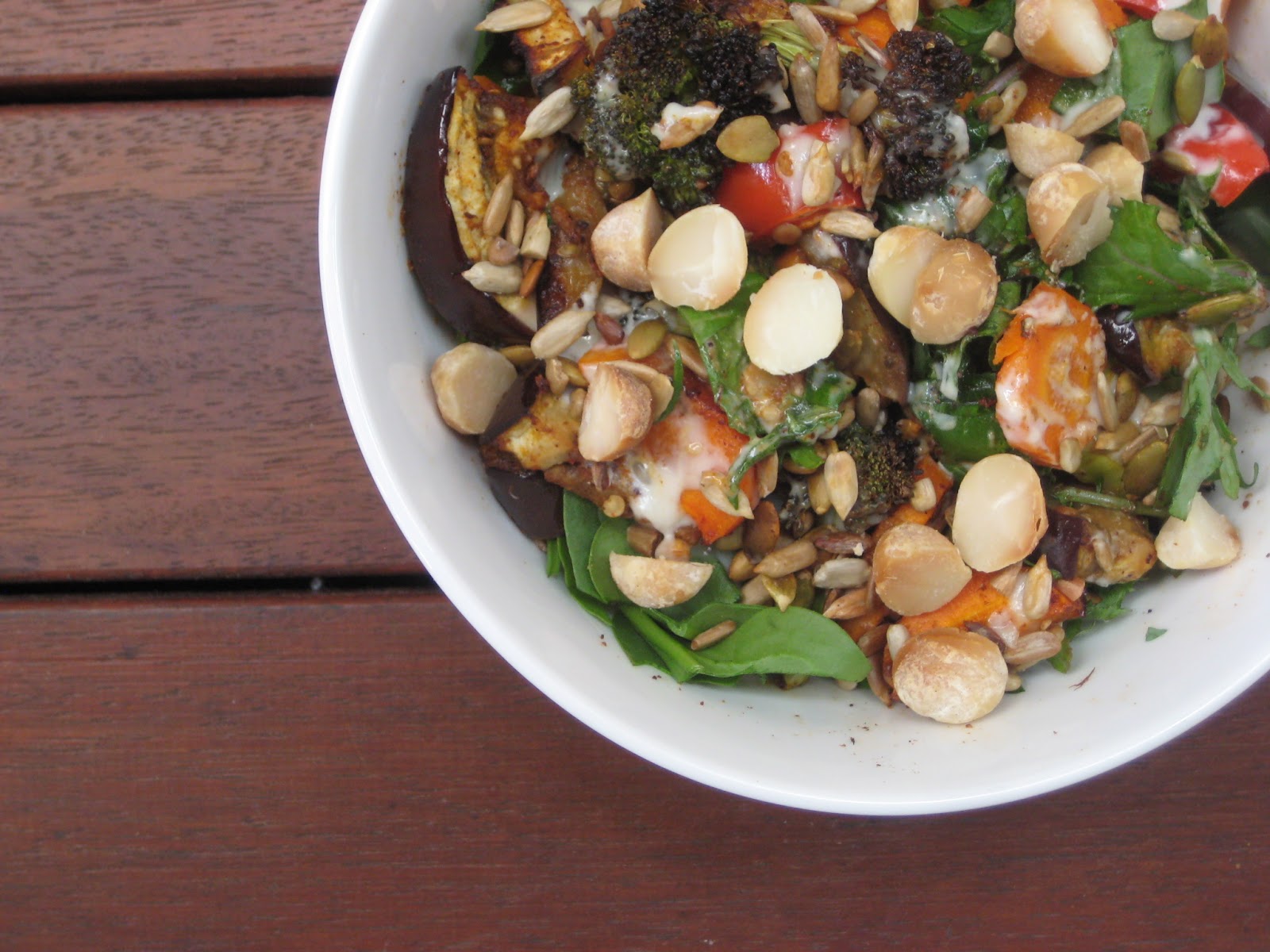
for the salad -
- 2 large handfuls organic baby spinach leaves, washed
- 2 handfuls organic baby kale leaves, washed and roughly chopped
- 2 large carrots, peeled and cut into thick slices
- 1 small red capsicum, washed, cored and cut into thick chunks
- 1 large head of broccoli, washed and cut into small florets
- 1/4 large eggplant,washed and cut into thick chunks
- 5-6 tbsp organic extra virgin coconut oil
- 1-2 handfuls organic macadamias
- large handful organic sunflower seeds
- large handful pumpkin seeds
- pinch Himalayan sea salt
- 2-3 tsp each of ground cumin, cayenne pepper, smoked paprika and ground sumac
for the dressing -
- 1 lime, freshly juiced
- 3 tbsp organic unhulled tahini
- 1 tbsp organic coconut nectar
- 1 tbsp organic coconut vinegar or organic apple cider vinegar
Preheat the oven to 180 degrees C.
Line a baking tray with baking paper (or aluminum foil).
Put the spinach and kale leaves in a serving bowl.
Place the chopped carrots, capsicum, broccoli and eggplant in the lined tray. Drizzle the coconut oil over the vegetables and sprinkle with all of the spices. Use your hands to rub the oil and spices all over the vegetables.
Bake for 35 minutes, until the vegetables are golden and fragrant.
In the last 10 minutes of baking - i.e. 25 minutes into baking time - place the macadamia nuts, sunflower seeds and pumpkin seeds into another baking tray and bake until golden and roasted.
To make the dressing, whisk together the lime juice, tahini, coconut nectar and vinegar.
Spoon the roasted vegetables over the salad leaves and scatter with the seeds. Use a sharp knife to halve the roasted macadamias before adding them to the salad. Drizzle the dressing over the salad, and serve.
Or do as I do, and top with a soft boiled (organic, free- range) egg.
'More protein and good fats,' did I hear you say? Bingo. Good work.
Or do as I do, and top with a soft boiled (organic, free- range) egg.
'More protein and good fats,' did I hear you say? Bingo. Good work.
Sunday, 7 April 2013
my spinach & mixed nut bread + a seeded mustard omelette
Gluten- free bread.

Even looking at those three words makes me wrinkle my nose.
Is it just me, or does gluten- free bread have a problem with sticking together? I mean, the stuff is crumbly. As in, it crumbles easily. As in, if you try to spread anything on it, it falls apart and leaves you with several pieces of torn bread.
No, worse than that - you don't even need to spread anything on it. When you use it to make a sandwich and then take a bite, it still breaks in your hands and leaves you with several pieces of torn bread. And as an added bonus, it also leaves your hands covered with sandwich fillings.
That one characteristic of gluten- free bread is the main reason I avoided the stuff for so long.
Okay, perhaps I shouldn't have boycotted all gluten- free bread. Maybe there are actually decent versions out there that do stay in one piece when you bite into it. Maybe I just haven't tried the right brands yet.
But alas! I am still haunted by the memory of that flight back in 2010. It was a Melbourne- to- Sydney flight that lasted a painstaking 1 hour and 45 minutes. All I did was take a bite of my gluten- free bread. One bite. And I was left with breadcrumbs all over my clothes, lap and blanket for the rest of the flight. I then accidentally ran my fingers through my hair and ended up with more crumbs in my hair and on my face.
The woman sitting across the aisle had glanced over at me and then shook her head ever- so- slightly in dismay. The air stewards also looked perplexed. Rightfully so - I looked like I had chosen to throw breadcrumbs all over myself instead of eat my dinner.
Anyway, if anybody can recommend a good brand of gluten- free bread, I am brave enough to try it now. And by "good brand", I mean something that will not only stay intact when bitten into, but also something that will pack a nutritional punch and taste amazing.
Can't think of any? Well, never fear! Here I have my recipe for a spinach and mixed nut bread that satisfies those three criteria. I love to eat it by itself - the aroma and the crunch of nuts just does it for me. But I also love it with this seeded mustard omelette of mine. And this omelette is one I eat at least a couple of times a week. This meal just makes me (and my tastebuds) very happy.
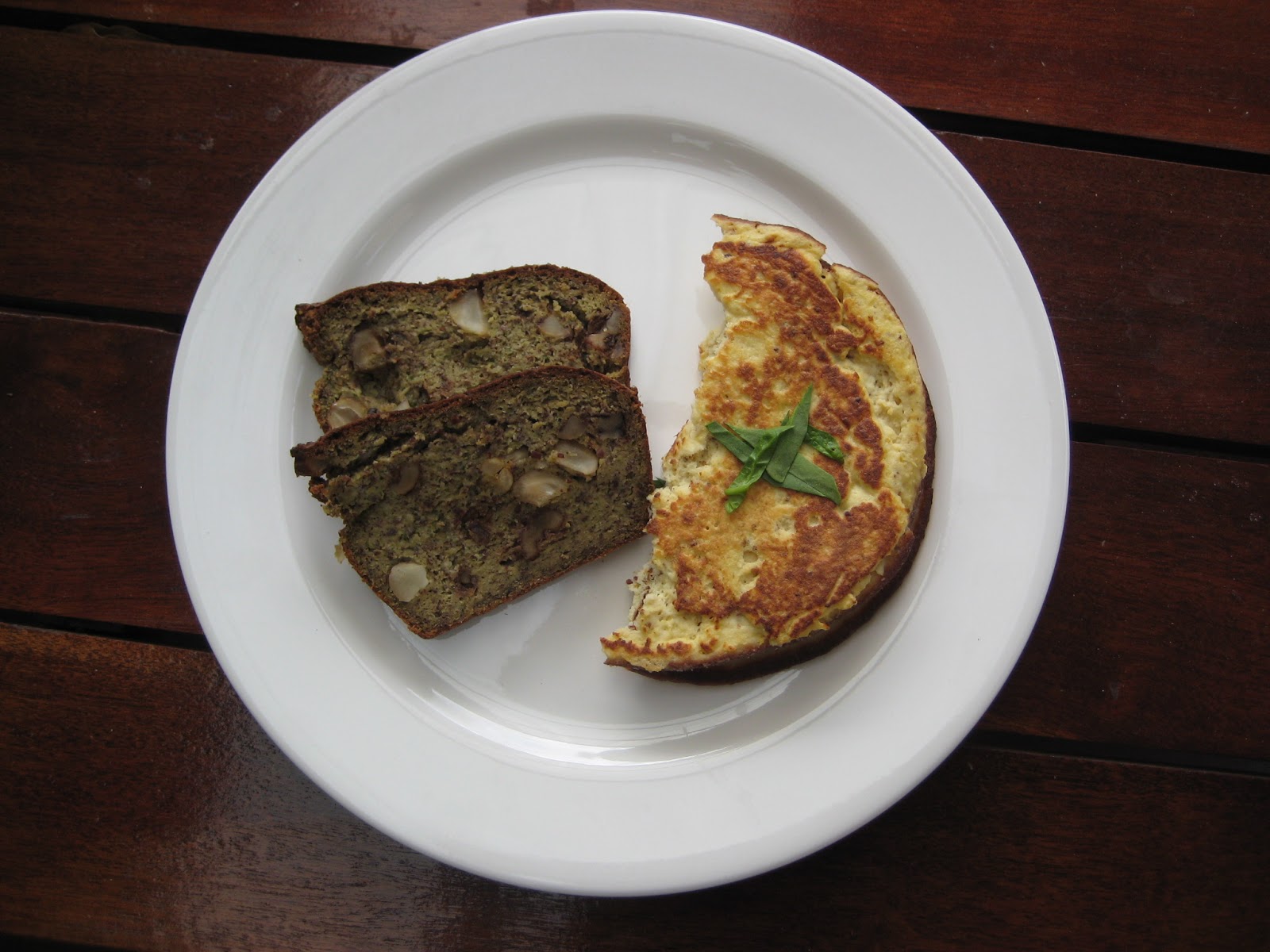
my spinach & mixed nut bread
makes 1 loaf
- 3 cups almond meal
- 1/4 cup organic unsalted cashews, oven- roasted and roughly chopped
- 1/4 cup organic unsalted macadamia nuts, oven- roasted and roughly chopped
- 1/4 cup unsalted walnuts, oven- roasted and roughly chopped
- 1/4 cup organic coconut palm sugar
- 2 tbsp gluten- free baking powder
- 2 tsp xanthan gum
- 1/2 tsp organic Himalayan sea salt
- 4 organic, free range eggs, whisked
- 1/4 cup organic extra virgin coconut oil, melted
- 1 cup (firmly packed) organic baby spinach leaves, washed
- 1 cup organic, unsweetened almond milk
Preheat the oven to 180 degrees C.
In a large bowl, combine the almond meal, coconut palm sugar, baking powder, xanthan gum and sea salt.
Put the spinach leaves and half of the almond milk (i.e. 1/2 cup only) into a food processor or blender and whizz for about 30 seconds until it is well blended.
In another large bowl, combine the whisked eggs, spinach mixture, the coconut oil and the remainder of the almond milk.
Pour the wet ingredients over the dry ingredients and use a large metal spoon to mix well.
Scatter the oven- roasted nuts over the batter and mix well with the spoon.
Pour / scoop the batter into a silicon loaf pan - you could probably use a greased and lined metal loaf tin instead - and bake for 35 minutes on the middle shelf. A deep brown crust will develop.
Take the loaf pan out of the oven & carefully cover with a sheet of aluminium foil. Bake for a further 35-40 minutes. Leave it in the pan for 10-15 minutes before turning it onto a cooling rack, and then leave for a further 15 minutes before slicing it with a sharp knife.
my seeded mustard omelette
serves 1
- 1/2 tbsp organic seeded mustard
- 2 organic, free range eggs
- 2 tbsp organic, unsweetened almond milk
- 1/2 tbsp organic extra virgin coconut oil
Put the seeded mustard, eggs and almond milk into a bowl & whisk until well combined.
Heat a nonstick saucepan over medium- high heat and swirl the coconut oil around. Pour the egg mixture into the saucepan.
When the sides of the omelette start to cook and set, use a wooden spatula to drag the cooked sides into the centre of the omelette. You can use a metal one if that is all you have - just be careful not to ruin the nonstick surface of your saucepan. This should allow the uncooked egg to dribble out to the sides and start cooking.
Continue to do this until the omelette is almost entirely cooked through - you might need to lift the saucepan and swirl it around towards the end, to help the uncooked egg reach the sides of the pan.
When the omelette is almost entirely cooked, turn off the heat and leave it for a few minutes. The residual heat will continue to cook the egg.
Carefully slide the omelette onto a plate to serve.
It is already (very) tasty like this, but you may add toppings if you wish. I recommend fresh slices of tomato, a bit of sliced Spanish onion, some organic feta and a small handful of fresh mint and basil leaves. Perfect.
Subscribe to:
Posts (Atom)